
Know the herbs
Scientific name
Cananga odorata (Lam.) Hook. F. & ThomsonFamily
AnnonaceaeLocal name
Kenanga, semendarasaDescription
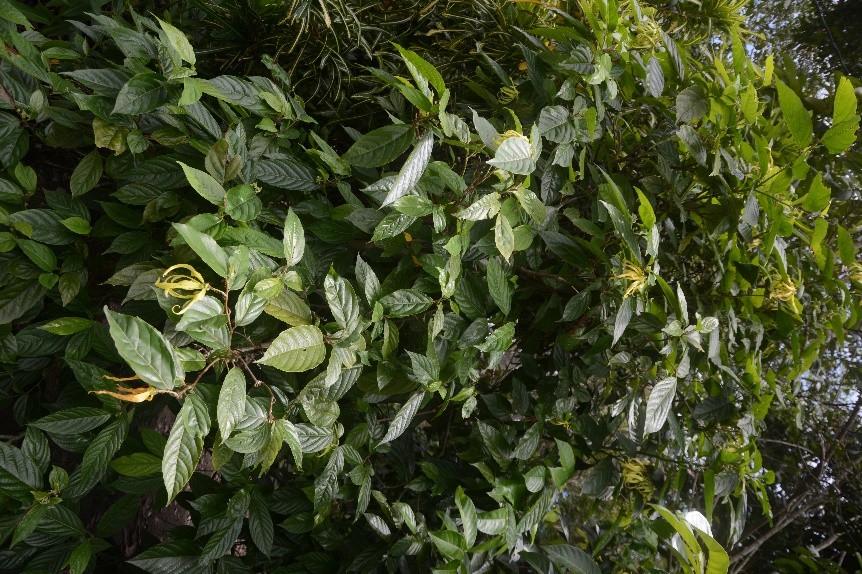
Cananga odorota can grow up to 30 m tall. The dry branches are dark brown or black. The tree is without branches, the smooth trunk is pale gray or silver. The leaves are simple and alternate. The leaves are thin and papery, the dry leaves are dark brown to gray to brown on the upper surface of the leaves, while the lower surface of the leaves is slightly pale. The leaves are hairy on both surfaces. When the leaves reach maturity, the upper surface becomes glabrous except for slightly hairy on the midrib while the lower surface is densely hairy. The leaves are ovate to ovate-oblong or ovate-lanceolate. The leaf apex is acuminate; the leaf base is cuneate, rounded or cordate. The midrib and secondary veins are slightly raised on the upper surface of the leaves while they are prominent on the lower surface. There are 7-13 pairs of secondary leaf veins. Flower clusters are axillary or terminal, racemose. The flowers are bisexual, fragrant, have three sepals, and six petals. The fruits are monocarpic, up to 20 or more, globose or ellipsoid, often segmented, the dry fruits are black and glabrous. Has four seeds in one monocarp, brown when dry and smooth surface.
Usage
Cananga odorota is used as a preparation for flower baths, care for mothers after childbirth, to shrink the uterus, as a majun ingredient, as a massage oil ingredient, to relieve vein pain, restore body freshness, relieve yellow fever, treat sinusitis, flatulence, gastritis, and hemorrhoids, control high blood pressure, and control blood glucose levels. Kenanga is used as a preparation for flower baths, care for mothers after childbirth, to shrink the uterus, as a majun ingredient, as a massage oil ingredient, to relieve vein pain, restore body freshness, relieve yellow fever, treat sinusitis, flatulence, gastritis, and hemorrhoids, control high blood pressure, and control blood glucose levels.
Malaysia Herbal Monograph (source: Globinmed)